KTZed Exposed: Katheryn Zierk Accuses GT of Impersonating Law Enforcement After Filing Police Report
Katheryn M. Zierk accused Georgia Transparency of impersonating law enforcement after GT exposed the person behind KTZed and reported on her police report. The timeline raises serious questions about her claim.

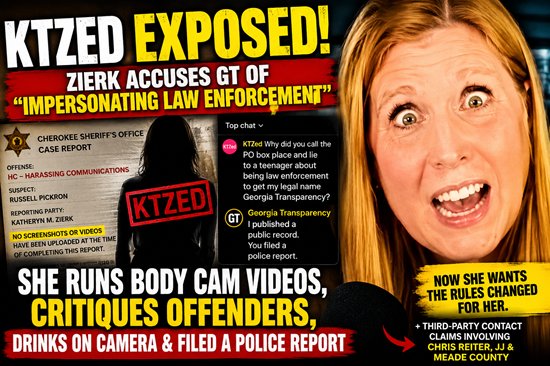


Katheryn M. Zierk is once again at the center of an online controversy — this time after publicly accusing Georgia Transparency of impersonating law enforcement to obtain her legal name.
The accusation appeared during a livestream on or around May 22, 2026, when an account using the name KTZed repeatedly confronted Georgia Transparency in the live chat.
One of the most serious comments stated:
“Why did you call the PO box place and lie to a teenager about being law enforcement to get my legal name Georgia Transparency?”

That is a major accusation.
It is also the kind of accusation that requires evidence.
And based on the timeline, screenshots, and public records reviewed by GT News Now, Zierk’s accusation appears to leave out one very important fact:
Georgia Transparency had already exposed who KTZed was based on her public YouTube comments and online conduct.
Only after that exposure did Zierk file a police report.
Now, Zierk appears to be trying to recast the story as if Georgia Transparency’s reporting began with some secret or deceptive attempt to obtain her identity. But the available record shows a different sequence: a public online account made public comments, Georgia Transparency identified the person behind that account, Zierk filed a police report, and that report later became part of the public record.
The Timeline Matters
This story did not begin with a police report.
It began with public online activity.
Georgia Transparency exposed the identity behind the online account KTZed after reviewing comments and conduct connected to that account on YouTube. Those comments became part of a larger public accountability story involving Zierk’s online behavior, her statements about others, and her role in the body-camera commentary community.
After GT exposed who KTZed was, Zierk filed a harassment-communications report with the Cherokee Sheriff’s Office.
That order of events matters.
Because now, Zierk appears to be suggesting that Georgia Transparency improperly obtained her identity by pretending to be law enforcement. But the public controversy had already begun because of her own online conduct and the exposure of the KTZed account.
In other words, Zierk was not randomly pulled into the public spotlight.
She was identified after public YouTube comments and online behavior became part of a public accountability story.
Zierk Filed the Police Report After Being Exposed
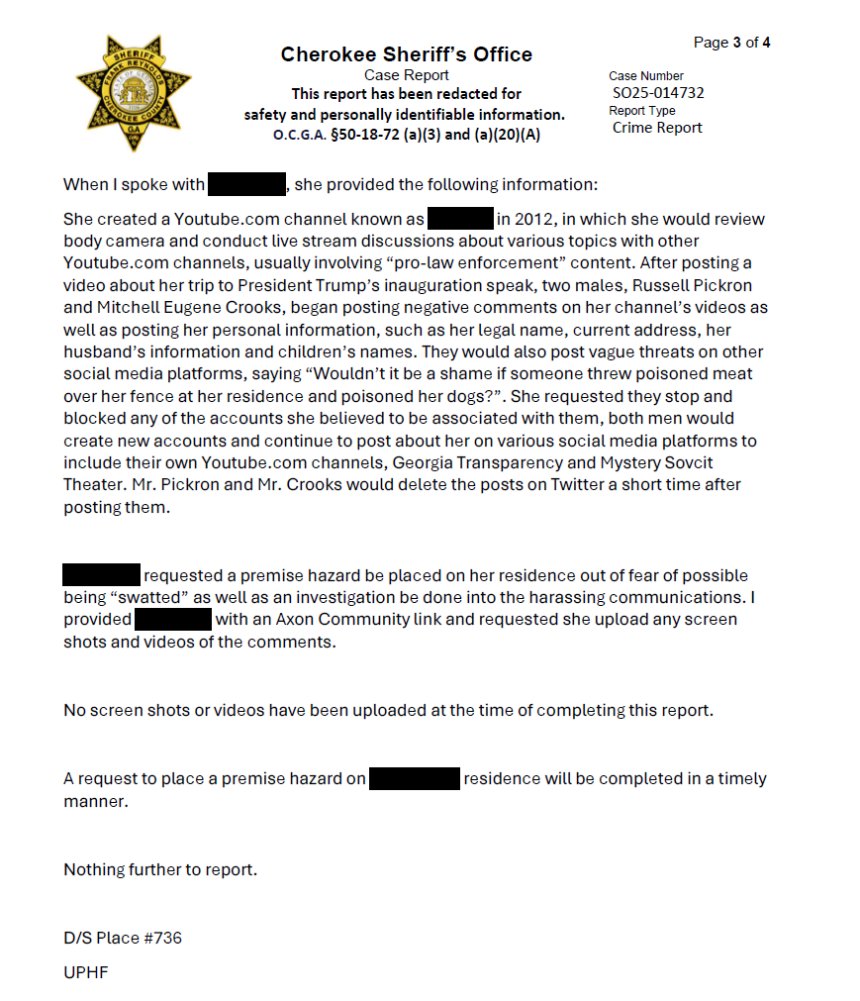
A Cherokee Sheriff’s Office case report lists the offense as harassing communications and names Russell Pickron as a suspect.
According to the report, Zierk told law enforcement she created a YouTube channel in 2012 where she reviewed body-camera footage and participated in livestream discussions with other YouTube channels, usually involving “pro-law enforcement” content.
That detail is important.
Zierk is not a private citizen who has never participated in public commentary. By her own statement to law enforcement, she has spent years in an online environment built around public records, body-camera footage, police encounters, criminal allegations, and commentary about other people’s conduct.
That does not mean Zierk has no right to privacy or safety. She does.
But it does mean she understands the public nature of body-camera content, police records, online criticism, and internet accountability.
The Body-Cam Critic Now Objects to Being Critiqued
Zierk has participated in content centered on reviewing body-camera footage and critiquing the actions of people involved in police encounters.
In videos and livestream appearances reviewed by GT News Now, Zierk appears on camera while seemingly drinking alcohol as she discusses alleged offenders, public incidents, police activity, and online controversies.
That context matters.
For years, people captured on body-camera footage have had their worst moments reviewed, mocked, analyzed, clipped, replayed, and criticized online. Zierk participated in that world.
But when her own public online conduct became the subject of scrutiny, and when her own police report became part of the public record, Zierk appeared to demand a completely different standard.
When the footage involves someone else’s arrest, breakdown, mistake, or police encounter, public commentary is apparently fair game.
But when the public record points back at Zierk, she calls it harassment, doxxing, and now accuses Georgia Transparency of impersonating law enforcement.
That double standard is difficult to ignore.
Zierk made content out of other people’s worst moments. Now that her own public internet conduct is being examined, she wants the rules changed.
The Police Report Followed the Exposure
The most important part of this story is the timeline.
Georgia Transparency first exposed who KTZed was after reviewing public YouTube comments and online conduct.
Then Zierk filed a police report.
That police report then became a public record.
Georgia Transparency reported on that public record.
Now Zierk appears to be using the existence of that public-record reporting to accuse GT of misconduct.
But a public police report does not become off-limits simply because the person who filed it regrets the attention it brought.
When someone files a report naming another person and making allegations to law enforcement, that report can become subject to public-record review, redactions, and reporting.
That is not harassment.
That is public accountability.
The Report Itself Raises Questions
According to the Cherokee Sheriff’s Office report, Zierk alleged that after she posted a video about attending President Trump’s inauguration speech, two men — Russell Pickron and Mitchell Eugene Crooks — began posting negative comments about her online.
The report states that Zierk alleged her personal information was posted, including her legal name, current address, husband’s information, and children’s names. She also alleged vague threats were made on other social media platforms, including a statement about poisoned meat being thrown over a fence.
Those are serious claims.
Nobody should be threatened. Nobody’s children should be targeted. Nobody should be swatted or placed in danger because of internet drama.
But the report also includes a critical detail:
“No screen shots or videos have been uploaded at the time of completing this report.”
That sentence matters.
At the time the report was completed, the officer had not received screenshots or videos supporting the allegations.
That does not automatically mean Zierk was lying.
But it does mean the public should be cautious before accepting every allegation as proven fact.
And it means Zierk’s newest claim — that Georgia Transparency impersonated law enforcement — deserves the same level of scrutiny.
Where is the recording?
Where is the transcript?
Where is the witness statement?
Where is the report proving that GT claimed to be law enforcement?
A live-chat accusation is not evidence.
The Third-Party Contact Claim Involving Chris Reiter and JJ of Meade County
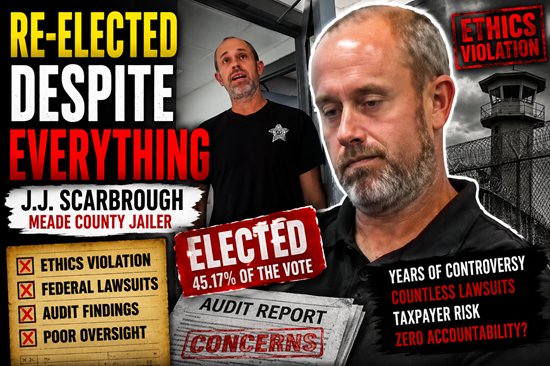
Another important part of this story involves Zierk’s references to alleged third-party contact connected to Chris Reiter and JJ of Meade County.
That detail matters because it appears to expand Zierk’s claims beyond the KTZed exposure and beyond her police report. Instead of simply disputing Georgia Transparency’s reporting about her public online conduct, Zierk appeared to connect GT to a broader dispute involving other people, other public matters, and other ongoing accountability stories.
If Zierk is claiming Georgia Transparency acted as a third party to contact, influence, intimidate, or communicate through someone else regarding Chris Reiter or JJ in Meade County, then that is another serious accusation that requires proof.
The public deserves to know exactly what she is alleging.
Who was supposedly contacted?
When did this contact happen?
What was allegedly said?
What evidence supports it?
And most importantly: is this a documented fact, or is it another unsupported accusation being pushed in the middle of an online feud?
Georgia Transparency’s reporting on Meade County, Chris Reiter, and related public accountability matters has involved serious issues of government conduct, jail conditions, public records, and alleged misconduct. Those stories are matters of public interest.
Attempting to recast public reporting as improper “third-party contact” does not make it true.
If Zierk has evidence that GT used someone as a third party to violate a legal boundary, she should produce it.
But if this is simply another attempt to attach Georgia Transparency to unrelated controversy involving Reiter, JJ, or Meade County, then it belongs in the same category as the impersonation claim: a serious allegation being made without publicly produced evidence.
That is why the timeline matters.
First, GT exposed the identity behind KTZed based on public YouTube comments and online conduct.
Then Zierk filed a police report.
Then the police report became public record.
Then Zierk appeared in a livestream accusing GT of impersonating law enforcement.
And now, references to third-party contact involving Chris Reiter and JJ of Meade County appear to widen the net even further.
The question is simple:
Is Zierk presenting evidence, or is she trying to bury the original issue under a pile of new allegations?
A Public Record Is Not “Doxxing”
During the livestream, Zierk repeatedly demanded to know why Georgia Transparency published information connected to her legal name, address, and employer.
GT responded:
“I published a public record. You filed a police report.”
That is the central issue.
Police reports are government records. When a person files a police report accusing another person of wrongdoing, that record may become available under public-record laws, subject to legal redactions.
A person cannot file allegations with law enforcement, place another person’s name into an official government record, and then demand that nobody report on that record once it becomes inconvenient.
Public records do not stop being public because the person who created the record dislikes the coverage.
That said, GT News Now believes private information should be handled responsibly. Home addresses, children’s names, phone numbers, and other sensitive details should be redacted where appropriate.
But reporting on the existence of a police report, the allegations inside it, and the public conduct surrounding it is journalism.
It is not automatically doxxing.
It is not automatically harassment.
And it is not impersonating law enforcement.
Zierk Asked for a Premise Hazard
The Cherokee Sheriff’s Office report also states that Zierk requested a premise hazard be placed on her residence because she feared possible “swatting.” The report indicates the request would be completed.
To be clear: swatting is dangerous. It is not a joke. Nobody should be falsely reported to law enforcement in a way that could place them or their family at risk.
But fear of swatting does not make every critic a criminal.
It does not erase the public interest in a police report.
It does not make public-record reporting unlawful.
And it does not prove that Georgia Transparency impersonated anyone.
The public can take safety concerns seriously while still questioning whether Zierk is using serious accusations to silence criticism.
Both things can be true.
The Livestream Escalation
The screenshots from the livestream show Zierk pressing Georgia Transparency repeatedly.
At one point, she wrote:
“Answer the question Georgia Transparency what was the journalist purpose of publishing my home address and employer?”
Later, she wrote:
“So what was the journalist purpose of publishing my full legal name and home address Georgia Transparency?”
GT answered:
“I published a public record. You filed a police report.”
That answer may not satisfy Zierk, but it is a direct answer.
The report exists because Zierk filed it.
The record exists because she contacted law enforcement.
The public scrutiny exists because she made allegations involving other people and placed those allegations into an official government document.
That is how public records work.
Then Came the “Impersonating Law Enforcement” Claim
The most serious accusation from last night was Zierk’s claim that Georgia Transparency called a PO box location and lied to a teenager by claiming to be law enforcement in order to obtain her legal name.
Again, that is a serious accusation.
If true, it would deserve serious attention.
But if false, it is also serious.
Publicly accusing someone of impersonating law enforcement can damage their reputation, their credibility, their platform, and their business.
That is why allegations like this should not be thrown around casually in a livestream chat.
If Zierk has evidence, she should release it.
If there is a recording, she should publish it.
If there are witnesses, she should identify them.
If a police agency investigated that specific accusation, she should provide the report.
But based on what has been made public so far, the confirmed timeline is not that GT impersonated law enforcement.
The confirmed timeline is this:
Georgia Transparency exposed the person behind KTZed based on public YouTube conduct.
Zierk then filed a police report.
That report became a public record.
Georgia Transparency reported on it.
Zierk then entered a livestream and accused GT of impersonating law enforcement.
That accusation now needs proof.
Free Speech Cuts Both Ways
During the livestream, Zierk also wrote:
“I’ve never changed anything about how I act on the internet or in person. Are you admitting you were trying to curtail my 1st amendment right to free speech?”
GT responded:
“KTZed, I can’t stop your 1A speech. Are you ok?”
That exchange captures the contradiction.
Zierk is free to speak.
She is free to criticize.
She is free to operate a YouTube channel.
She is free to discuss body-camera footage, police encounters, criminal defendants, public officials, and other creators.
But Georgia Transparency is also free to respond.
GT is free to report on public records.
GT is free to scrutinize accusations made in a police report.
GT is free to question whether a public online commentator is applying a double standard when the scrutiny turns back toward her.
The First Amendment is not a one-way shield.
It protects Zierk’s right to speak.
It also protects the right of others to report, criticize, respond, and investigate.
Public Commentary Comes With Public Accountability
Zierk cannot have it both ways.
She cannot participate in a content world built around reviewing other people’s police encounters, criminal allegations, body-camera footage, and public embarrassment — then claim that scrutiny becomes harassment when she is the subject.
She cannot file a police report naming other people, then act shocked when the report becomes part of the public conversation.
She cannot publicly accuse Georgia Transparency of impersonating law enforcement without producing evidence and expect that accusation to go unchallenged.
She also cannot appear to drag Chris Reiter, JJ, and Meade County into the discussion as alleged third-party contact without clearly explaining the allegation and producing evidence to support it.
Public commentary comes with public accountability.
Accountability is not harassment simply because it is uncomfortable.
And journalism is not misconduct simply because the subject dislikes the story.
The Real Story
The real story is bigger than one livestream comment.
The real story is about online creators who build platforms around criticizing others, then claim victimhood when their own conduct is examined.
The real story is about public records being used to make allegations, then being called harassment when journalists report on them.
The real story is about a woman who allegedly made nasty comments online, participated in body-camera commentary culture, appeared in livestreams seemingly drinking while critiquing others, and then filed a police report after Georgia Transparency exposed who was behind KTZed.
Now, after that report became public, Zierk is accusing GT of impersonating law enforcement and appears to be expanding the controversy by referencing alleged third-party contact involving Chris Reiter and JJ of Meade County.
Those claims demand evidence.
Not emotion.
Not vague chat comments.
Not internet outrage.
Evidence.
Final Word
Katheryn M. Zierk made content out of other people’s worst moments.
She reviewed body-camera footage.
She critiqued alleged offenders.
She participated in livestream discussions involving police encounters, public records, and online controversy.
Then Georgia Transparency exposed who was behind KTZed based on public YouTube comments and online conduct.
After that, Zierk filed a police report.
That report became public.
Georgia Transparency reported on it.
Now Zierk wants to frame the story as if GT somehow crossed the line by reporting on records and conduct connected to her own public activity.
But public records do not become private because the person who filed them regrets the attention.
And serious accusations do not become true simply because they are typed into a livestream chat.
If Zierk has proof that Georgia Transparency impersonated law enforcement, she should release it.
If Zierk has proof that GT engaged in improper third-party contact involving Chris Reiter, JJ, or Meade County, she should release that too.
Until then, the documented timeline tells a different story:
KTZed was exposed.
Zierk filed a police report.
GT reported on the public record.
Then Zierk accused GT of impersonating law enforcement without publicly producing evidence.
Now the controversy appears to be widening into claims involving third-party contact, Chris Reiter, JJ, and Meade County — again without public proof.
That is not accountability from Zierk.
That is damage control.
And the public deserves better than damage control.
Files
Share
What's Your Reaction?
 Like
3
Like
3
 Dislike
0
Dislike
0
 Love
0
Love
0
 Funny
2
Funny
2
 Angry
0
Angry
0
 Sad
0
Sad
0
 Wow
1
Wow
1