PIT, Pursue, Payday: How Georgia State Patrol Chases Turned Into Insurance Cash Demands
Investigative report exposing Georgia State Patrol pursuit cases involving PIT maneuvers, insurance demand letters, and repeated $25,000 settlements tied to police chases and crash claims.
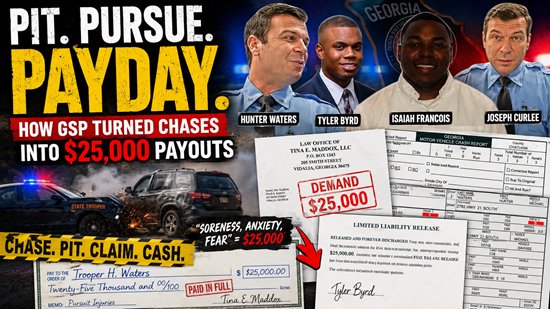
For years, the Georgia State Patrol has publicly sold high-speed pursuits as a matter of public safety — dangerous suspects, heroic troopers, split-second decisions.
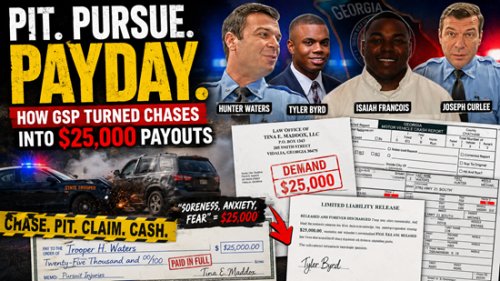
But a review of crash reports, pursuit narratives, insurance demand letters, and settlement releases paints a far more disturbing picture: a pattern where violent PIT maneuvers and aggressive pursuits repeatedly ended not only in crashes — but in private insurance payouts to the very troopers involved.
The records raise serious ethical questions about whether some officers crossed the line from law enforcement into financial self-interest.
And taxpayers should be asking why.
A Repeating Pattern
The documents reveal the same cycle over and over again:
- Troopers engage in or escalate a pursuit.
- PIT maneuvers are performed.
- Civilian vehicles crash, spin, flip, or strike property.
- Troopers later claim soreness, emotional distress, fear, or anxiety.
- Demand letters are sent to private insurance companies seeking policy-limit settlements.
In multiple cases, the demands were for exactly $25,000 — the standard Georgia minimum bodily injury liability limit.
The pattern appears so repeatedly that it begins to look less like coincidence and more like a system.
The Hunter Waters Cases
Trooper Hunter Waters appears repeatedly throughout the records.
And each incident follows nearly the same formula.
Case One: The Home Depot PIT
On February 15, 2024, Waters joined a pursuit in Chatham County involving Caesar Thompkins. According to the demand letter, Waters accelerated to speeds exceeding 100 mph before conducting a PIT maneuver near a Home Depot/Walmart parking lot.
The letter acknowledges Waters did not seek medical treatment.
Yet despite no medical care, the letter demanded the full $25,000 policy limit from GEICO for:
- soreness,
- body aches,
- anxiety,
- fear,
- and emotional distress from the pursuit.
The demand package framed the incident as creating “potential liability” far beyond policy limits if the insurer refused to pay.
In other words:
Pay now — or risk financial devastation.
Case Two: The Marijuana Chase
Another Waters pursuit occurred October 1, 2022 involving Rashaan McCloud. The records describe Waters smelling marijuana, initiating a stop, and later performing a PIT maneuver after the driver allegedly attempted to flee.
Again:
- no medical treatment,
- no documented hospitalization,
- no significant injury diagnosis.
But once again:
another $25,000 insurance demand.
A signed liability release later confirmed Waters accepted a $25,000 settlement tied to the crash.
That raises a deeply uncomfortable ethical question:
Should a trooper financially benefit after intentionally using a tactical maneuver designed to cause a collision?
Because PIT maneuvers are not accidental contact.
They are deliberate impacts.
Case Three: The Downtown Savannah Pursuit
The third Waters case may be the most alarming.
On April 1, 2023, Waters joined a pursuit through Savannah streets crowded with pedestrians and traffic. According to the records, the suspect vehicle struck another car before Waters performed a PIT maneuver that caused the fleeing SUV to rotate, strike a sidewalk, hit a railing, and partially roll over.
Again:
- no medical treatment,
- no emergency injury documentation,
- but another policy-limit insurance demand.
The wording across these letters is strikingly similar — almost boilerplate.
The same emotional injuries.
The same “fear and anxiety.”
The same threat of excess liability exposure.
The same $25,000 target.
And the same law office.
The Tyler Byrd Files
The Byrd cases follow a nearly identical structure.
A July 2025 demand letter sought $25,000 from Kemper Insurance after another pursuit-related crash.
The letter aggressively warned the insurer that failure to comply could expose the insured to judgments against:
- wages,
- assets,
- and future earnings.
In another Byrd case, court records show the claim ultimately settled and was dismissed with prejudice after a limited liability release was executed.
Again:
another pursuit,
another settlement,
another payout.
The Francois Pursuit
The Isaiah Francois records may expose the most dangerous conduct of all.
The pursuit narrative describes:
- multiple GSP vehicles,
- speeds exceeding 100 mph,
- PIT maneuvers through residential areas,
- near collisions,
- crashes into private property,
- armed confrontations,
- and repeated tactical escalation.
One narrative describes troopers continuing the pursuit through downtown Savannah despite acknowledging pedestrian risks. Another describes a PIT maneuver near homes that sent the suspect vehicle crashing through fencing and into residential property.
The reports even document multiple juveniles inside the vehicle.
Yet despite the extraordinary danger created by the pursuit itself, the aftermath again shifted toward civil liability exposure and injury-related claims.
The Ethical Problem
This is where the issue stops being about “bad drivers.”
And starts becoming about ethics.
Law enforcement officers are entrusted with enormous authority:
- the power to chase,
- to ram vehicles,
- to use force,
- to escalate encounters,
- and to decide whether a pursuit continues.
That authority comes with a duty to avoid even the appearance of personal financial interest.
But these records raise serious concerns that some pursuits may have created financial incentives completely incompatible with ethical policing.
Because once officers become potential insurance claimants, a dangerous conflict emerges:
Did officers escalate these pursuits solely for public safety?
Or did the crashes themselves become financially valuable events?
Even if every single payout was technically legal, ethical policing requires more than legality.
It requires public trust.
And public trust collapses when:
- tactical collisions repeatedly become insurance claims,
- officers receive payouts after intentional vehicle impacts,
- and citizens are left wondering whether pursuit decisions were influenced by money.
The Questions Georgia Must Answer
The public deserves transparency on several critical issues:
- How many GSP troopers have received private insurance settlements after pursuits or PIT maneuvers?
- Does Georgia DPS track these claims internally?
- Are troopers required to disclose settlement payments?
- Are supervisors auditing pursuits where troopers later become claimants?
- Are there policies preventing financial conflicts tied to enforcement actions?
- How many PIT-related settlements have been quietly resolved without public scrutiny?
Because if police chases are repeatedly ending in personal insurance payouts for the officers involved, then Georgia may not simply have a pursuit problem.
It may have a systemic ethics problem.
Share
What's Your Reaction?
 Like
0
Like
0
 Dislike
0
Dislike
0
 Love
0
Love
0
 Funny
0
Funny
0
 Angry
0
Angry
0
 Sad
0
Sad
0
 Wow
0
Wow
0