FEDERAL COURT KEEPS FIRST AMENDMENT CLAIMS ALIVE AGAINST TWO MEADE COUNTY JAIL EMPLOYEES
Meade County dismissed from lawsuit, but Brandon Finch and Rebecca Webster must continue defending allegations involving protected legal mail


MEADE COUNTY, Ky. — A federal judge has refused to throw out First Amendment claims against two Meade County Detention Center employees, finding that sworn testimony creates genuine disputes of material fact over allegations that an inmate’s protected legal mail was repeatedly opened outside his presence.
While Meade County itself succeeded in obtaining summary judgment on Daniel R. Clemans’s failure-to-train claim, detention-center employees Brandon Finch and Rebecca Webster did not receive summary judgment on the legal-mail allegations. Those claims remain pending following the August 31, 2026, Memorandum Opinion and Order in Clemans v. Scarborough, et al., U.S. District Court for the Western District of Kentucky, Case No. 3:24-CV-00334.
The distinction is important. Finch and Webster have not yet been adjudged liable, but neither did the federal court clear them of Clemans’s allegations. Instead, the court determined that the competing sworn evidence creates factual disputes that cannot be resolved in their favor at the summary-judgment stage.
That means the First Amendment claims against the two employees continue.
Federal law gives legal mail heightened protection
Clemans alleged that Finch and Webster opened legal correspondence outside his presence, delayed or misplaced legal mail, and interfered with obtaining copies and other materials associated with court filings. The court’s decision makes clear that legal mail is not treated like ordinary inmate correspondence.
The judge relied heavily on the Sixth Circuit’s decision in Sallier v. Brooks, 343 F.3d 868 (6th Cir. 2003). Under Sallier, prisoners retain a First Amendment right to receive mail, and legal correspondence receives special protection because it may affect a prisoner’s legal rights, attorney-client confidentiality and access to the courts.
The federal court also cited Wolff v. McDonnell, 418 U.S. 539 (1974) and Knop v. Johnson, 977 F.2d 996 (6th Cir. 1992) for the principle that corrections officials may inspect protected legal mail for contraband in the prisoner’s presence.
As the court explained, constitutionally protected legal mail may be opened for inspection, but that does not give jail officials unrestricted authority to secretly open or read it.
That legal distinction is now central to what Finch and Webster must continue defending.
Sworn witnesses kept the claims alive
What ultimately prevented Finch and Webster from winning summary judgment was not simply another allegation written in a complaint.
Clemans submitted sworn evidence.
Among it was an affidavit from inmate Tyler Petty, who stated that he saw Clemans receive legal mail from Finch and Webster that was already opened. Petty further claimed Clemans repeatedly questioned why his legal mail had been opened and alleged that he witnessed disputes over legal mail that had gone missing and later been located.
Other submitted statements described alleged difficulties obtaining copies, notarizations and materials necessary for court filings.
Finch and Webster denied the allegations.
The defense attempted to attack the inmate witnesses using housing records, arguing that some of those individuals did not share a cell with Clemans during the periods described.
But the federal judge was not persuaded that those records eliminated the factual dispute.
The court specifically stated that although the defendants had gone to considerable lengths to show that the witnesses may not have shared Clemans’s cell, it was still conceivable that they personally witnessed the events without sharing a cell with him.
That conclusion is legally significant because of another Sixth Circuit case cited by the court: Lamb v. Kendrick, 52 F.4th 286 (6th Cir. 2022).
Under Lamb, a prisoner’s sworn affidavit can, standing alone, create a genuine dispute of material fact sufficient to prevent summary judgment. The district court also cited El Bey v. Roop, 530 F.3d 407 (6th Cir. 2008) for the rule that a properly verified complaint may serve as affidavit evidence at summary judgment.
In other words, the court could not simply decide whose story was more believable.
Clemans says h is legal mail was opened.
Other sworn witnesses say they saw opened legal mail delivered to him.
Finch and Webster deny doing it.
That credibility dispute remains unresolved.
And the judge concluded that summary judgment was therefore inappropriate for either side on those First Amendment claims.
This is no longer just an allegation surviving initial screening
That procedural history matters.
Federal civil-rights lawsuits filed by prisoners are initially screened by the court. Surviving that stage means only that a plaintiff has alleged enough to potentially state a claim.
This case has gone much further.
The parties conducted discovery.
Evidence was submitted.
Affidavits were filed.
The defendants asked the federal court to decide that no reasonable factfinder could rule against them and to end the claims without trial.
Under Rule 56, summary judgment may be granted only when there is “no genuine dispute as to any material fact” and the moving party is entitled to judgment as a matter of law. The court relied on the Supreme Court’s decisions in Celotex Corp. v. Catrett, 477 U.S. 317 (1986) and Anderson v. Liberty Lobby, Inc., 477 U.S. 242 (1986) in explaining that standard.
On the legal-mail claims against Finch and Webster, that standard was not satisfied.
The court said no.
Not because Finch and Webster have already been proven liable, but because there is enough conflicting evidence that the dispute cannot simply be resolved in their favor on paper.
Meade County wins its own claim — but that raises another accountability question
Meade County itself obtained summary judgment on Clemans’s § 1983 failure-to-train theory.
Municipal liability is governed by Monell v. Department of Social Services, 436 U.S. 658 (1978). Under Monell, a county cannot ordinarily be held liable simply because one of its employees allegedly violates someone’s constitutional rights. The plaintiff must demonstrate that an official policy, custom or municipal decision was the moving force behind the constitutional injury.
The court also relied on City of Canton v. Harris, 489 U.S. 378 (1989) and Connick v. Thompson, 563 U.S. 51 (2011) in discussing failure-to-train liability.
Those cases set an exceptionally demanding standard. A plaintiff generally must show that policymakers were deliberately indifferent to an obvious training deficiency or were on notice through repeated similar constitutional violations and nevertheless failed to correct the problem. The resulting constitutional injury must be a highly predictable consequence of that failure.
Clemans did not meet that evidentiary burden.
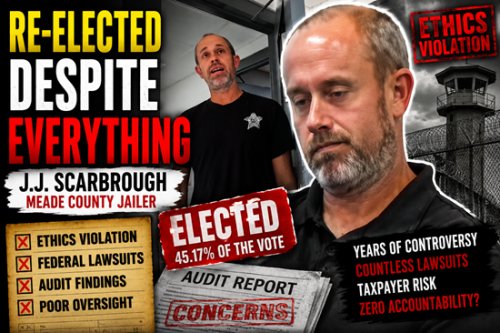
Although he pointed to Meade County’s training appropriations and alleged a broader pattern of misconduct, the County presented training records and certifications. Jailer J.J. Scarborough stated that Finch, Brown and Webster had satisfied Commonwealth training requirements.
The judge ultimately concluded that Clemans had not produced sufficient evidence of inadequate training and had therefore failed to establish the causal connection necessary to hold Meade County itself liable under Monell.
Meade County is therefore out of the lawsuit.
But that ruling creates an uncomfortable public-accountability question of its own.
Meade County successfully defended itself by showing that its employees were trained. Yet two of those employees must continue defending allegations that they nevertheless engaged in conduct that, if proven, could violate clearly established First Amendment protections concerning legal mail.
The County’s own evidence regarding legal-mail procedure further sharpens that question.
Finch maintained that clearly marked legal mail was supposed to be given to an inmate so that the inmate could open it in a deputy’s presence. He denied opening Clemans’s legal mail beforehand.
That leaves two dramatically different versions of events.
The official position is that protected mail was handled according to procedure.
The plaintiff and sworn witnesses say protected legal mail arrived already opened.
A federal judge has now determined that the conflict between those accounts is substantial enough that it cannot be resolved through summary judgment.
County dismissed. Constitutional claims remain.
The August 31 order substantially narrowed the lawsuit. The court dismissed Clemans’s remaining medical, mental-health, religious-exercise and municipal failure-to-train claims. Amber Brown and Meade County were terminated as defendants.
But the court expressly left Clemans’s First Amendment legal-mail claims against Brandon Finch and Rebecca Webster alive.
That is where the case now stands.
No jury has yet found Finch or Webster liable.
No final judgment has established that either employee violated Clemans’s constitutional rights.
But after discovery and competing motions for summary judgment, they were unable to obtain dismissal of the First Amendment claims against them.
The remaining question is now fundamentally factual:
Were Clemans’s constitutional protections respected, as Finch and Webster contend, or was his protected legal correspondence being opened outside his presence, as Clemans and sworn witnesses allege?
Unless the case is otherwise resolved, that is the kind of credibility determination that belongs to the factfinder—not to one side simply declaring itself cleared.
For Meade County, the legal victory is real: the County itself defeated Clemans’s Monell claim.
But so is the unresolved constitutional controversy emerging from inside its detention center.
The County may be out. The First Amendment case is not.
Files
Share
What's Your Reaction?
 Like
2
Like
2
 Dislike
0
Dislike
0
 Love
0
Love
0
 Funny
0
Funny
0
 Angry
0
Angry
0
 Sad
0
Sad
0
 Wow
0
Wow
0