
MEADE COUNTY CONNECTION ROCKED: J.J. SCARBOROUGH BUSINESS PARTNER ARRESTED ON FELONY STALKING AND DOMESTIC-VIOLENCE-RELATED CHARGES
Direct D owner Christopher Ruff taken into custody after entering an Arizona courthouse as livestream statements expose prior knowledge, outstanding-warrant concerns, and preparations for his possible incarceration


APACHE COUNTY, ARIZONA — Christopher Dane Ruff, the owner and personality behind the YouTube channel Direct D, was taken into custody on July 27, 2026, after entering the courthouse in St. Johns, Arizona, according to a livestream broadcast from his channel and a publicly displayed inmate-booking entry supplied to Georgia Transparency.
The arrest carries significance far beyond one Arizona YouTube channel.
Ruff has also been publicly connected as a business partner of Meade County, Kentucky, elected Jailer J.J. Scarborough, raising new questions about Scarborough’s judgment, associations, and repeated proximity to individuals involved in serious legal controversies.
The booking entry identifies Ruff as being held by the Apache County Sheriff’s Office under booking number 39201, with five listed counts:
- A.R.S. § 13-3601 — Domestic Violence, listed as a felony;
- A.R.S. § 13-2921(A)(1) — Harassment by Contact or Communication, listed as a misdemeanor;
- A.R.S. § 13-2904(A)(3) — Disorderly Conduct involving Language, listed as a misdemeanor;
- A.R.S. § 13-2923(A)(2) — Stalking involving Fear of Death, listed as a felony; and
- A.R.S. § 13-2923(A)(1) — Stalking involving Emotional Distress, listed as a felony.
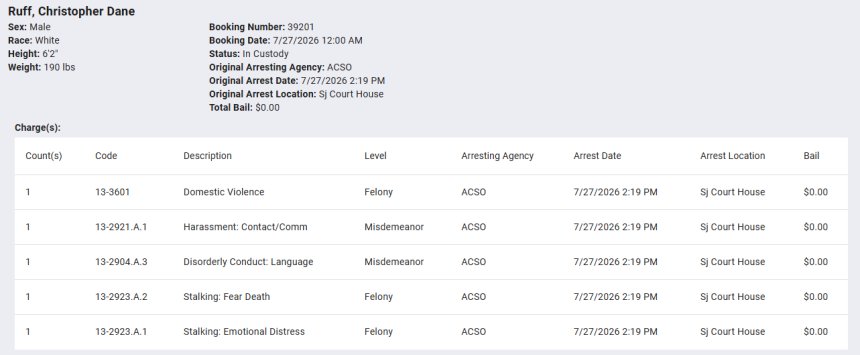
The booking information showed Ruff as in custody, with $0 bail displayed at the time of the screenshot. That does not necessarily mean Ruff can never receive release conditions or a bond. It may mean that no release amount had yet been set, that he was being held pending an initial appearance, or that the jail system had not yet been updated.
Ruff is presumed innocent unless and until proven guilty in court.
The most serious allegation: stalking involving fear of death
The most severe charge shown in the booking entry is stalking under A.R.S. § 13-2923(A)(2).
Under Arizona law, that subsection applies when someone intentionally or knowingly engages in a course of conduct directed at another person that causes the alleged victim to reasonably fear death—either their own death or the death of certain family members, household members, domestic animals, livestock, or others identified by the statute. It is classified as a Class 3 felony.
The separate emotional-distress stalking allegation falls under subsection A(1). That provision covers a course of conduct causing significant emotional distress or reasonable fear of physical injury or property damage. It is generally classified as a Class 5 felony.
Arizona’s stalking statute requires more than a single unpleasant interaction. It defines a “course of conduct” to include repeated proximity, threats, unauthorized electronic surveillance, or repeated electronic communications directed at a specific person without authorization and without a legitimate purpose. The law expressly excludes constitutionally protected and otherwise lawful activity.
Therefore, the criminal case will likely turn on several critical questions:
What specific conduct is alleged? How many incidents occurred? What communications or threats are claimed? Was the conduct directed at a particular person? What evidence supports the alleged fear of death or emotional distress?
Those details cannot be determined from the booking page alone.
The “domestic violence” entry needs careful explanation
The booking page labels A.R.S. § 13-3601 as “Domestic Violence” and identifies it as a felony. However, § 13-3601 generally operates as a domestic-violence designation tied to an underlying criminal offense and a qualifying relationship. The statute includes offenses such as harassment, stalking and certain forms of disorderly conduct when committed against a spouse, former spouse, household member, relative, co-parent or current or former romantic partner.
Arizona law specifically says the offense carries the classification assigned to the underlying crime.
That means the booking display should not automatically be interpreted as proving an additional, independent act of physical violence. The actual complaint, warrant, probable-cause statement or indictment will be necessary to determine:
- Which underlying count carries the domestic-violence designation;
- The alleged relationship between Ruff and the complainant;
- Whether any physical injury, weapon or threat was alleged; and
- Why the jail system separately displayed § 13-3601 as a felony count.
The word “domestic violence” is legally serious, but responsible reporting requires distinguishing the statutory designation from assumptions that physical assault necessarily occurred.
Harassment through contact or communications
The misdemeanor harassment charge references A.R.S. § 13-2921(A)(1).
That law applies when a person knowingly contacts or causes communications with another person by verbal, electronic, telephone, written or similar means in a manner that legally constitutes harassment. The conduct must be directed at a specific person, would cause a reasonable person to be seriously alarmed, annoyed, humiliated or mentally distressed, and must actually have that effect on the alleged victim. Harassment under subsection A is a Class 1 misdemeanor.
This charge may involve calls, text messages, emails, social-media communications, livestream statements or communications sent through another person. But the booking entry does not reveal which form of communication prosecutors are relying upon.
Disorderly conduct involving abusive language
The booking page also lists disorderly conduct under A.R.S. § 13-2904(A)(3).
That subsection is narrower than merely using profanity or offensive words. It applies when a person, intending or knowing that they are disturbing another person’s peace, uses abusive or offensive language or gestures toward someone who is present in a manner likely to provoke immediate physical retaliation. It is a Class 1 misdemeanor.
This element is important because offensive speech alone is not automatically criminal. The precise setting, words, conduct, proximity and likelihood of an immediate violent reaction will matter.
Michelle’s livestream: uncertainty, admissions and unanswered questions
Following Ruff’s arrest, a woman identified during the broadcast as Michelle went live on the Direct D channel to update viewers.
She said Ruff entered the St. Johns courthouse to file paperwork and that she remained outside in a vehicle. According to her account, Ruff later emerged from the courthouse in handcuffs accompanied by three sheriff’s deputies.
Michelle repeatedly told viewers that she did not yet know exactly why Ruff had been arrested. At first, she speculated that the arrest involved Maricopa County warrants. She also said Ruff was expected to appear in court the following morning.
But several statements from the livestream deserve closer examination.
“He kind of knew this was coming”
Michelle initially described the arrest as a “blindside.” Later, however, she told the audience:
“He kind of knew this was coming at some point.”
She further stated that Ruff had asked her to be present at his property because, should he “have to go away,” she could care for his dog and other animals.
She described earlier discussions in which she had offered to retrieve Ruff’s dog if something happened. According to Michelle, Ruff then invited her to move to the property so they would be “covered” if he were taken away.
Those statements do not establish guilt. They do, however, create an important factual tension between the arrest being portrayed as entirely unexpected and Ruff having allegedly made advance arrangements based on the possibility of incarceration.
The courthouse and the protective-order proceeding
Michelle stated that Ruff went to the courthouse to address or “fight” a TPO, apparently referring to a temporary protective order or similar proceeding.
She also indicated that she was personally connected to a protective-order dispute but claimed she would not contest an order against her because she was content to have no contact with the other person.
The timing raises a central question:
Was Ruff arrested on an existing warrant when courthouse personnel identified him, or was the arrest directly related to conduct alleged in the protective-order case?
Michelle stated that officers had previously been at Ruff’s property but had not arrested him. She expressed confusion about why law enforcement waited until he appeared at the courthouse.
One plausible explanation is that deputies executed an active warrant after confirming Ruff’s presence at a controlled public location. But that remains an inference until the warrant and court docket are obtained.
Fundraising before the charges were known
During the livestream, Michelle repeatedly encouraged viewers to donate money for Ruff’s possible bond—even while acknowledging that she did not yet know the charges, whether a bond would be imposed or the amount of any potential bond.
She stated that donation links would be placed in the chat and told viewers that Ruff needed funds for “possible bond.”
There is nothing inherently improper about raising legal-defense or bond funds. Nevertheless, transparency requires clear answers:
- Who controls the donation account?
- Is the money specifically restricted to bond or legal expenses?
- What happens if Ruff is released without a monetary bond?
- Will donors receive an accounting of how the money is used?
- Are donations going directly to Ruff, Michelle, an attorney or another person?
The livestream transcript does not provide those answers.
Immediate dismissal of a stalking allegation
When someone in the chat apparently mentioned stalking, Michelle reacted:
“Stalking? What the fuck ever?”
She then appeared to defend Ruff, asserting that he wanted nothing to do with the person involved.
That reaction came while she was simultaneously saying she did not know exactly what the case involved.
The contradiction is significant: the public was being asked to financially support Ruff while a spokesperson dismissed at least one allegation before reviewing the probable-cause statement, warrant or evidence.
Support for a friend is understandable. But confidently rejecting an allegation without knowing the factual basis is not an evidentiary rebuttal.
The Meade County question: why is J.J. Scarborough repeatedly surrounded by controversy?
Ruff’s arrest is an Arizona criminal matter, and J.J. Scarborough has not been charged in connection with it.
But Scarborough is not merely a private citizen. He is the elected jailer of Meade County, Kentucky—a public official entrusted with the operation and security of a correctional institution.
According to information previously examined by Georgia Transparency, Scarborough and Ruff have been publicly associated through a business relationship. That connection makes Ruff’s arrest a legitimate matter of public interest, particularly because Scarborough has repeatedly inserted himself into online disputes involving critics, YouTube personalities and individuals connected to ongoing litigation.
The relevant question is not whether Scarborough is legally responsible for Ruff’s alleged conduct. He is not, absent evidence showing involvement.
The legitimate questions are:
What due diligence did Scarborough perform before entering a business relationship with Ruff?
When did Scarborough learn about Ruff’s warrants, protective-order litigation or potential criminal exposure?
Did Scarborough continue conducting business with Ruff after becoming aware of those issues?
Were any county resources, jail access, official influence, merchandise, money or public-office connections used to benefit Ruff or the Direct D channel?
Does Ruff possess or control any footage, records, business information or other material obtained through his relationship with the elected jailer?
Will Scarborough publicly disclose the nature and financial terms of their business dealings?
An elected official cannot reasonably demand public trust while treating his private partnerships as immune from scrutiny—especially when those partners become involved in serious felony proceedings.
What the evidence currently proves—and what it does not
The available materials presently support the following:
- A booking entry identifies Christopher Dane Ruff as having been taken into custody on July 27, 2026.
- The entry lists two felony stalking allegations, a domestic-violence-related entry, misdemeanor harassment and misdemeanor disorderly conduct.
- Michelle stated on Ruff’s channel that he was arrested after entering the St. Johns courthouse.
- She said she initially believed the arrest might involve Maricopa County warrants.
- She acknowledged prior preparations for the possibility that Ruff could “go away.”
- She stated Ruff had gone to the courthouse in connection with paperwork and a protective-order dispute.
- She solicited donations for possible bond expenses before publicly confirming the charges or bond conditions.
The materials do not presently establish:
- The identity of the alleged victim;
- The exact factual allegations supporting each count;
- Whether the charges came from one incident or multiple incidents;
- Whether the allegations involve online content, direct communications or physical encounters;
- Whether Ruff threatened anyone;
- Whether a weapon was involved;
- Whether prosecutors have formally filed all charges displayed by the jail;
- Whether Ruff has entered a plea;
- Whether any count will be amended or dismissed; or
- Whether J.J. Scarborough had advance knowledge of the alleged conduct.
Those answers should come from the arrest warrant, probable-cause affidavit, charging complaint, protective-order filings and audio or video of the initial court appearance.
The records Georgia Transparency should obtain next
The strongest follow-up investigation should seek:
- The arrest warrant and return of service;
- The probable-cause statement;
- The criminal complaint and case number;
- Ruff’s initial-appearance recording or minute entry;
- Release conditions and any no-contact order;
- The underlying protective-order petition and hearing history;
- Relevant Maricopa County warrant records;
- Any police reports, body-camera footage and courthouse surveillance footage;
- Communications specifically cited as harassment or stalking evidence; and
- Business records documenting Ruff’s relationship with J.J. Scarborough.
Until those documents are obtained, the booking entry is evidence of an arrest and listed allegations—not proof that every accusation is true.
Conclusion
Christopher Ruff built an online platform that regularly commented on other people’s arrests, court battles and personal controversies.
Now, Ruff is the person in custody.
The allegations displayed by the Apache County booking system are not minor. They include stalking that allegedly caused fear of death, stalking that allegedly caused emotional distress, harassment, disorderly conduct and a domestic-violence designation.
At the same time, the livestream intended to rally support for Ruff produced its own serious questions. Michelle claimed the arrest was unexpected, yet described advance preparations for Ruff possibly being taken away. She admitted she did not know the evidence, yet dismissed the stalking allegation. And she sought donations for a possible bond before confirming whether any financial bond would even be imposed.
For the public in Meade County, the story carries another unavoidable dimension: Why does elected Jailer J.J. Scarborough continue to appear alongside business partners, online allies and associates whose conduct becomes the subject of criminal proceedings, civil litigation or public controversy?
Ruff deserves due process.
The alleged victim deserves protection and to have the claims evaluated fairly.
And the people of Meade County deserve complete transparency about their elected jailer’s business relationships.
Georgia Transparency will continue following the court record, obtaining the underlying documents and separating verified evidence from livestream speculation.
Share
What's Your Reaction?
 Like
1
Like
1
 Dislike
0
Dislike
0
 Love
2
Love
2
 Funny
1
Funny
1
 Angry
0
Angry
0
 Sad
1
Sad
1
 Wow
1
Wow
1














lol Direct D is in a rape cage right now